

STEREOCEPTOR: A New Philosophy, An Old Groove
Four Tampa Bay musicians on unfinished songs, finding the pocket, getting older, and why some things sound better the second time around.
There's something refreshingly difficult to categorize about Stereoceptor.
The Tampa Bay four-piece sounds simultaneously familiar and just outside of time. Their debut album, New Philosophy, moves effortlessly between elastic funk grooves, lush neo-soul harmonies, shimmering synthesizers, and the sort of sophisticated pop songwriting that used to dominate expensive recording studios.
It's also an unusually emotional record for something this consistently danceable.
One moment, the band is delivering an infectious, horn-driven dance track. A few songs later, we're listening to a man who may be the last person alive falling in love with a voice on the radio. By the album's closing minutes, an old home video has become the setting for one of the most affecting songs on the record.
Behind it all are four musicians who seem surprisingly uninterested in taking credit for how well everything works.
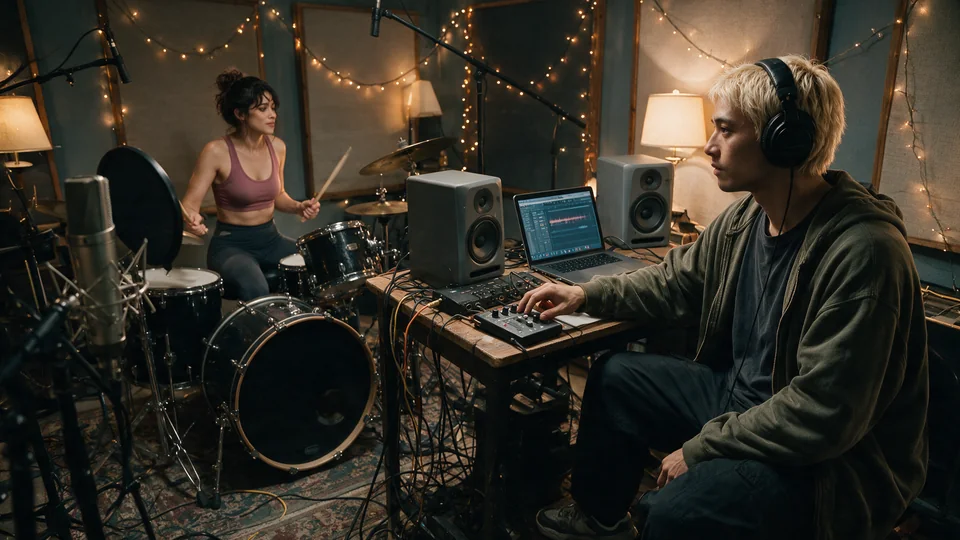
There's Graham Ellis, guitarist and one of the band's two primary vocalists, whose collection of unfinished musical ideas helped provide the album's foundation. Malcolm Bell, bassist and fellow lead vocalist, brings a seemingly bottomless enthusiasm for rhythm and an exceptionally deep pocket. Tessa Navarro is the drummer, an occasional lead vocalist, and, by several accounts, the person most likely to tell everyone when it's time to stop rehearsing. Rounding out the quartet is keyboardist Jun Park, whose Rhodes, synthesizers, and arrangements provide much of the band's harmonic character.
We caught up with all four ahead of the October 20 release of New Philosophy.
You all came together as working musicians rather than friends. When did it actually become a band?
Malcolm: That's a good question. I don't remember anybody officially asking.
Graham: I think we just started assuming everybody was coming back next week.
Tessa: That's pretty much what happened.
Jun: We should probably have discussed it.
Malcolm: We were all playing different gigs around the area. Tessa and I had worked together quite a bit. Graham started showing up on some of those dates, and Jun came into the picture later. Eventually we started getting together just to play stuff we liked.
Graham: I had a bunch of songs that weren't finished. Some of them barely qualified as songs. I'd bring something in, everybody would start playing, and suddenly we'd have something worth recording.
Tessa: Or we'd spend three hours on it and decide the original version was better.
Graham: That happened less often than she makes it sound.
Jun: It happened yesterday.
The album title, New Philosophy, seems appropriate for a band finally putting these songs out. Where did it come from?
Graham: There's a line in "Don't Stop" about changes I've been making being the result of a new philosophy. That phrase kind of stuck.
Malcolm: We talked about it, and it seemed to fit what we were doing. Not in some big philosophical sense. More like we finally stopped treating every song as something we might finish someday.
Tessa: We decided finishing things was allowed.
Graham: Which was a radical development.
Jun: We're still adjusting.

The record moves through a lot of styles. Is there something you consider the Stereoceptor sound?
Malcolm: The groove. That's where everything starts for me.
Tessa: I'm probably going to agree with Malcolm, which I try not to do too often.
Malcolm: Thank you.
Tessa: But yeah. We can have all the strange chords and synthesizers we want. If the rhythm section doesn't feel good, nobody cares.
Jun: I think there's a balance. We like complicated harmony, but we don't necessarily want the listener thinking about how complicated it is.
Graham: Right. It should feel good before you have to understand it.
Malcolm: And sometimes the best thing you can do is stop playing for a second.
Tessa: He's been trying to convince me of that for years.
Malcolm: You're getting there.

It should feel good before you have to understand it.
— Graham
Graham and Malcolm split the lead vocals pretty evenly. Is that deliberate?
Graham: Not really. We just try different things.
Malcolm: Certain songs work better with certain voices. Graham has a way of delivering something really vulnerable without overselling it. And I like singing the stuff with a little more attitude.
Graham: Although Malcolm sings some of the most beautiful stuff on the album.
Malcolm: Thank you, man.
Graham: See? Vulnerability. He's doing it right now.
Tessa: Can we move on?
Tessa, you also sing on three tracks. Why not more?
Tessa: Because somebody has to play the drums.
(Everyone laughs.)
Tessa: No, I love singing. I really do. But I'm happiest behind the kit. That's my thing. If there's a song where my voice brings something to it, great. If not, I'm perfectly happy playing drums.
Jun: She usually doesn't want to sing something until everybody else has already decided she should.
Tessa: That's not true.
Graham: It is a little true.
Tessa: Next question.
"Classic Case" might be one of the most entertaining songs on the record. The two of you sound like you're having a genuinely terrible relationship.
Graham: (Laughing) Thank you.
Tessa: I don't think that's a compliment.
Graham: I'll take it.
Tessa: That song was fun because neither person is really listening to the other. They're both convinced they're right.
Graham: And the funniest thing is that they sound great together.
Malcolm: That's my favorite part. Musically, they're completely locked in. They're harmonizing, answering each other's phrases, everything fits.
Jun: They're communicating perfectly. Just not about anything useful.
Tessa: Which is a pretty good description of some relationships.
Speaking of unusual relationships, there's "Maybelline." How did that song happen?
Graham: That one got a little out of hand.
Tessa: A little?
Graham: I had this idea about somebody who's been alone for a very long time and suddenly starts receiving a radio transmission. He hears this woman's voice, and it becomes this incredibly important thing to him.
Malcolm: It's a love song.
Graham: It really is.
Jun: It's just not a particularly conventional one.
Graham: Exactly. There's something heartbreaking about being so desperate for human connection that even the smallest suggestion of somebody else out there becomes everything.
Tessa: And then you realize what he's actually hearing.
Graham: Right. But I don't think the discovery makes his feelings any less real.
There's a lot of humor on the album, but there's also quite a bit of sadness. "Wonder" and "Time Slip Away" are even subtitled Nostalgia Parts One and Two.
Malcolm: Those are probably the two songs that connect most directly for me.
Graham: "Wonder" is about somebody who's no longer part of your life. You're wondering whether they think about you, but you're also hoping they're doing well. There's some peace in that, even if it still hurts.
Malcolm: And "Time Slip Away" is a little bigger than one relationship. It's about entire periods of your life that are gone.
Tessa: That one really gets me.
You take the lead on "Time Slip Away." Was that an obvious choice?
Tessa: Not originally. But when we started working through it, it just felt right.
I think everybody knows that feeling of coming across an old photograph or video and suddenly being right back somewhere you haven't thought about in years.
And then you notice somebody in the background. Someone you miss. Or you see yourself as a kid, or your parents when they were young.
And nobody in that recording knows what's coming.
Malcolm: That's what gets me. They're just having a normal day.
Tessa: Exactly. Nobody's trying to make a memory. They're just living. And years later, you'd give anything to have one more afternoon like that.
(There's a brief pause.)
Graham: We should probably talk about something funny now.
Tessa: Please.

Nobody's trying to make a memory. They're just living.
— Tessa Navarro
All right. "Move Like That." Should we be concerned about the narrator?
Malcolm: Absolutely.
Graham: Deeply.
Malcolm: It starts off as this sexy dance song, and then you realize this guy's behavior is getting increasingly difficult to justify.
Tessa: I love that the music never acknowledges how weird he's being.
Jun: That's important. If we made the arrangement sound funny, it wouldn't work.
Malcolm: Exactly. The band is taking the groove extremely seriously. The narrator is the only person who has completely lost control of the situation.
Graham: I'm not sure he'd agree with that assessment.
Tessa: He'd probably have a presentation prepared explaining why you're wrong.
"Two" feels like a quieter statement about contentment, even though the groove has a lot of swagger. Is that the album's central idea?
Malcolm: Maybe. It's about realizing you don't need everything you thought you needed.
Tessa: I like that it isn't saying you should stop wanting things. It's not saying ambition is bad.
Malcolm: Right. You can still have goals and plans. But if you're always waiting for something else to happen before you let yourself be happy, that's a difficult way to live.
Jun: It's also got one of my favorite chord progressions on the record.
Graham: There he is.
Jun: I was wondering when somebody would ask.
But if you're always waiting for something else to happen before you let yourself be happy, that's a difficult way to live.
— Malcolm Bell
What do you hope people take away from the album?
Graham: I hope they listen more than once. There's a lot going on musically, and I think some of the lyrics reveal themselves a little differently when you hear them again.
Jun: I hope they hear the arrangements. But not so much that they forget to enjoy the songs.
Malcolm: I want people to move. Even on the slower stuff, there's a pulse to this record. I want somebody to hear it and feel something physically.
Tessa: I just hope something on it reminds them of somebody.
Maybe it's a good memory. Maybe it's somebody they haven't talked to in a while. Maybe it makes them laugh.
That's the stuff I remember about records I've loved. Not necessarily every lyric or every chord. Just where I was, who I was with, and how it felt.
Malcolm: That's a pretty good answer.
Tessa: Don't sound so surprised.

STEREOCEPTOR — NEW PHILOSOPHY
Release date: October 20, 2026 10 tracks · 41 minutes
A record about the things we chase, the people we miss, the moments we misunderstand, and the occasional wisdom of just letting the groove carry you.